
Honed vs. Polished Stone: Which Finish Is Best for Colorado Homes?
August 18, 2026
Quick Answer: Polished stone has a mirror-like, reflective surface created by grinding it through progressively finer grits, while honed stone is stopped at a lower grit and left with a flat, matte-to-satin look with little to no reflection. Polished finishes show scratches, footprints, and etch marks more sharply because there’s a shine for every flaw to interrupt, while honed finishes hide that same wear because there’s no gloss to break. Honed surfaces also tend to offer better underfoot traction, which matters in entryways and bathrooms. In Colorado, where winter boots track in sand, gravel, and de-icing salt, the finish you choose changes how fast a floor starts to look worn and how it needs to be maintained. Neither finish is universally better — the right one depends on the room, the stone, and how the surface actually gets used.
You walk your dog around the block, come back through the mudroom, and cross the kitchen to refill the water bowl. Nobody thinks twice about it. But every one of those trips deposits a little sand, a little salt, a little grit onto whatever stone is underfoot. On a polished floor, that path shows up months later as a faint trail of dulled footsteps cutting through an otherwise glossy surface. On a honed floor in the same house, that same traffic barely registers. Same winter, same boots, same stone. Completely different outcome.
That gap is the whole decision, and it runs deeper than which finish looks shinier in a showroom. Honed and polished are two ways of finishing the exact same stone, and each one changes how the surface catches light, how it feels underfoot, how visibly it wears, and how it survives a Colorado winter. Here’s what actually separates them, room by room and season by season, so you can pick the finish that fits how your home gets used instead of how it looked on install day.
What “Honed” and “Polished” Actually Mean
A fabricator or restoration technician works the stone’s surface with a sequence of increasingly fine abrasives. Where that sequence stops determines the finish. That’s really the whole mechanism.
Polished stone is taken all the way through the grit progression. The surface gets sanded, ground, and buffed with finer and finer abrasives until it reaches a reflective, glossy state. There’s no single industry number that defines “polished” the way there is for honed grit levels. A true polish is judged by how much detail a reflection holds and from how wide an angle you can still see it. Stand over a well-polished floor near a window and you should be able to make out the shape of the window frame in the reflection, not just a vague smear of light.
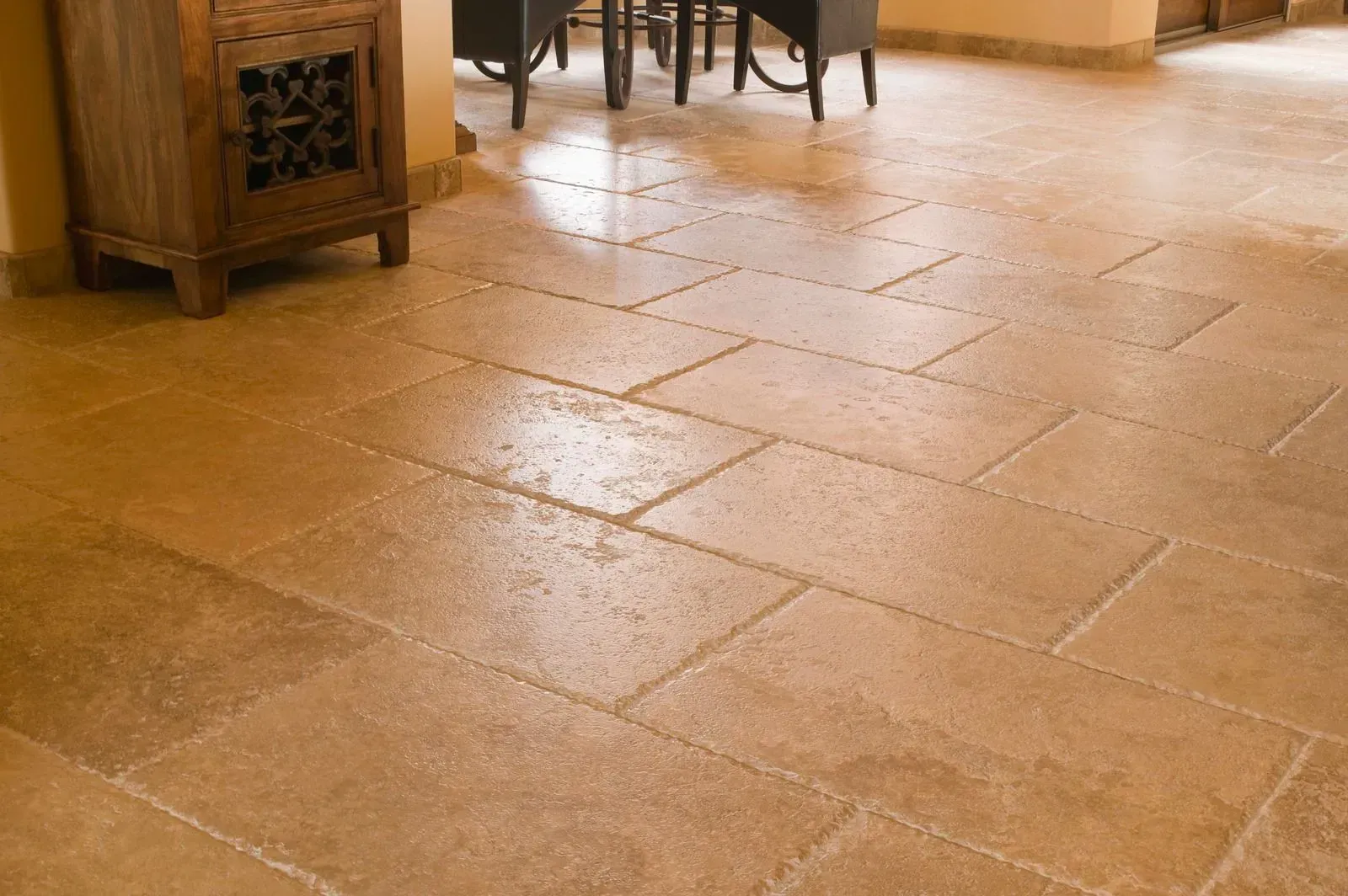
Honed stone is stopped short of that reflective endpoint. Any finish that doesn’t meet the standard for a true polish falls into the honed category, though honed itself has gradations. A matte hone typically lands around a 200 to 400 grit level and looks even and clean across the whole surface, with light showing up as no more than a soft glow if it shows at all. A satin hone sits closer to an 1800 grit finish — a step between matte and polished, where you might catch a vague outline of a light fixture looking straight down, but nothing sharp.
The stone underneath never changes. Marble stays marble and granite stays granite no matter which finish you choose; what’s changing is the surface texture, not the material. That’s why this choice has less to do with the stone species and more to do with which finish actually suits the room.
Appearance: How Each Finish Reads in a Room
The visual difference is the obvious one. But it’s worth understanding why it happens instead of just filing it under “shiny vs. matte.”
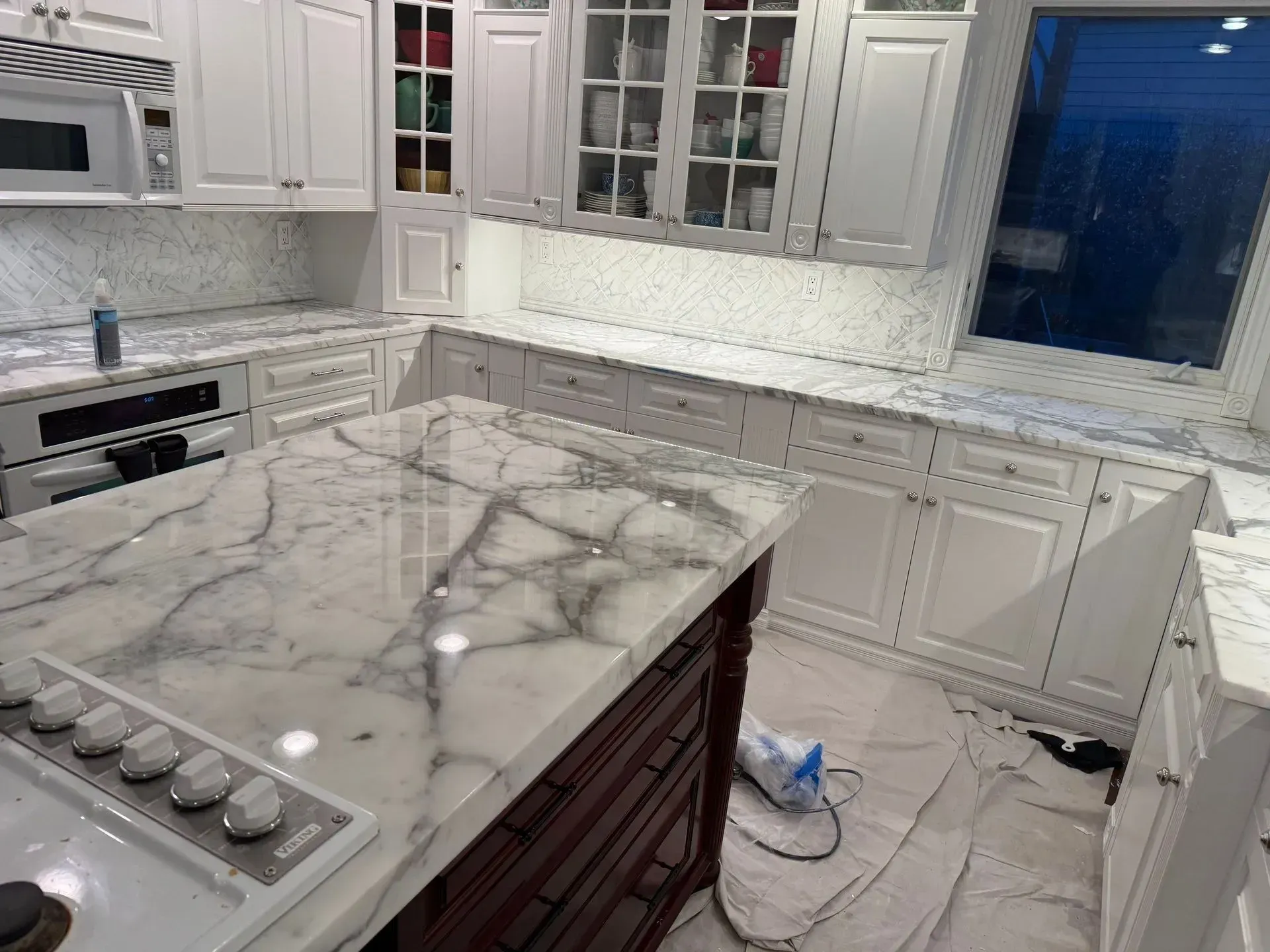
Polished finishes deepen color and add visual depth. The reflective surface bounces light back through the stone’s crystalline structure, which is why polished marble veining and polished granite flecking look more saturated and dimensional than the same pattern honed. This is the finish most people picture for a luxury kitchen island or a formal bathroom vanity.
Honed finishes mute color and soften the overall look. Without that reflective layer, veining and pattern read more subtly, and the stone takes on a warmer, more organic feel that plenty of homeowners actually prefer for large surfaces like floors, where a full-room mirror shine can feel cold. Colors generally look a shade or two more muted honed than polished, even though the stone underneath hasn’t changed at all.
Room lighting shifts how far apart the two finishes look. In a bright kitchen with a lot of natural light bouncing off windows, even a low-grit honed floor throws off some reflection at a wide enough angle. In a dim mudroom, or any room with limited natural light, the contrast between honed and polished gets much sharper — there’s simply less ambient light for a honed surface to catch.
Slip Resistance: Which Finish Is Safer Underfoot
Traction is where the two finishes stop being just a look and start being a safety question — for floors, at least.
Slip resistance on hard flooring is measured against a real benchmark. The American National Standard A326.3 sets a dynamic coefficient of friction, or DCOF, of 0.42 or higher as the accepted threshold for level interior floors expected to get wet underfoot. A rougher, less reflective surface generally tests higher on that scale than a smooth, polished one. That’s part of why honed and other textured finishes are the go-to recommendation anywhere a floor is likely to see water, snowmelt, or bare feet.
Honed floors generally offer more traction than polished floors of the same stone. The lower-grit surface has more microscopic texture for a shoe or bare foot to grip. That’s why honing is the more common choice for bathroom floors, entryways, and shower pans — the exact spots where water and wet feet meet stone every single day.
Polished floors aren’t automatically dangerous, but they demand more attention. A dry, clean, polished floor has plenty of traction. The risk shows up when water, snowmelt, dust, or oils sit on top of that smooth surface — exactly what happens in a Colorado entryway during a winter storm. Love the look of polished stone in a high-traffic area anyway? Pairing it with an anti-slip treatment and a strict no-water-sitting habit closes most of that gap.
Countertops don’t carry this concern at all. Nobody’s walking on a kitchen island, so the slip-resistance conversation really belongs to floors, showers, and any horizontal stone surface people stand on.
Maintenance: What Each Finish Hides and What It Shows
This is where the two finishes really pull apart in daily life. It’s also the piece homeowners tend to underestimate before they’ve lived with a floor or counter for a year.
Polished surfaces show every mark. Scratches, water spots, dust film, and etching from acidic spills all interrupt that mirror shine, so a polished countertop or floor announces even small damage almost right away. On acid-sensitive stones like marble, limestone, and travertine, an etch mark from lemon juice or wine reads as an obvious cloudy patch precisely because there’s a reflective surface for it to disrupt.
Honed surfaces mask that same wear far more effectively. No mirror shine means scratches, footprints, and light etching tend to blend into the finish instead of standing out against it. This is why honing is such a common fix for marble that’s already etched. Grinding the surface down to a fresh, even hone doesn’t just remove the damaged layer — it also leaves a finish that hides the next round of wear better than a polish would.
Both finishes still need sealing, and it matters more right after a honing job specifically. A penetrating sealer fills the stone’s pores to slow staining, and that protection has nothing to do with which finish sits on top. But honing exposes a fresh layer of stone. Skip sealing right after, and that newly opened surface is more vulnerable to soaking up spills than it was before the work even started.
pH-neutral cleaning applies to both finishes, though polished stone forgives a wrong product less easily. Acidic or abrasive cleaners can etch or scratch either surface, but the damage shows up more clearly on a polish — one more reason kitchens that see a lot of acidic spills often do better honed.
TIP: Repolishing and rehoning are not permanent, one-time decisions. High-use kitchen counters and foyers often need repolishing every one to three years, while honed surfaces in busy kitchens or commercial spaces typically go one to two years between honing services, with lower-traffic rooms stretching to three to five years. If you are not sure which schedule fits your stone, a professional evaluation based on your actual foot traffic beats guessing.
Best Rooms and Uses for Each Finish
Matching a finish to a room comes down to two questions. How much acid and water does this surface actually see? And how much shine do you want to live with?
Kitchen countertops are a toss-up that depends on the stone. Granite and quartzite handle a polish well since they resist etching, so a glossy polished island stays glossy. Marble and other calcium-carbonate stones etch easily from citrus, wine, and vinegar, so a honed or satin finish is the more forgiving pick for a counter that’s actually going to be cooked on.
Kitchen and entry floors lean honed for the traction and forgiveness reasons already covered. Water, dropped food, and tracked-in debris show up in these rooms daily, and a honed finish handles all three more gracefully than a polish does.
Bathroom floors and shower pans almost always favor honed or textured finishes for the slip-resistance benefit alone. A polished shower floor looks striking in a photo. It turns risky the moment it’s wet, which is most of the time.
Formal living areas, low-traffic foyers, and bathroom vanities are where polished finishes get to shine — literally. These are lower-traffic, lower-moisture surfaces where the reflective depth of a polish reads as intentional design instead of a maintenance headache.
Mountain homes and ski-in properties tend to favor honed floors throughout the common areas, given how much snow, slush, and grit comes through the door across a Colorado winter.
Colorado Considerations: Grit, De-Icing Salt, and What Winter Does to a Finish
Front Range and mountain homes deal with a maintenance variable milder climates never see: months of tracked-in winter debris landing straight onto stone floors.
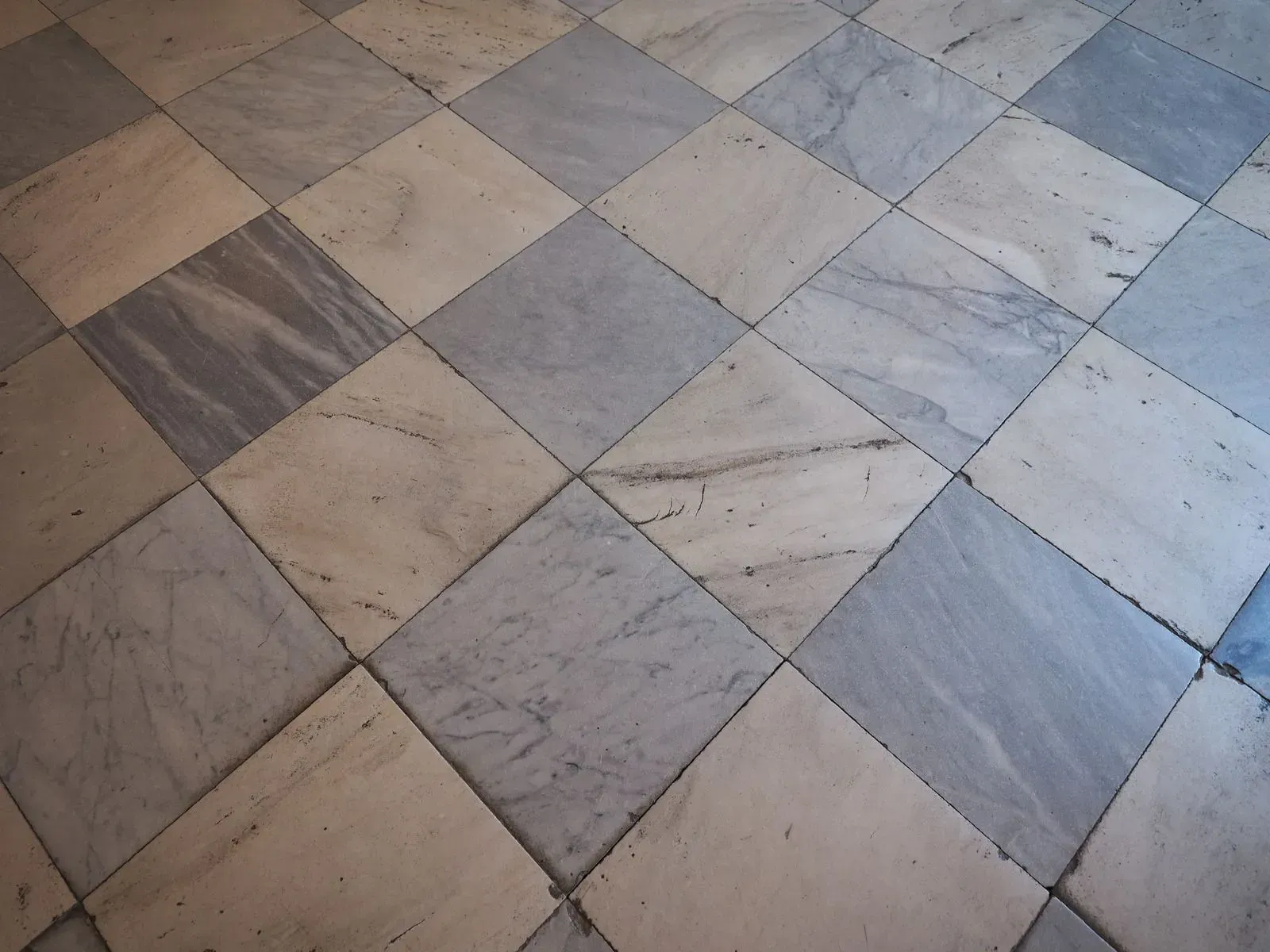
Every trip through a Colorado entryway from November through March brings in some mix of sand, gravel grit, and de-icing product clinging to boot soles. Grit is abrasive by nature. Repeated grinding of those small particles across a polished surface is a common source of the fine, swirling micro-scratches that dull a shine over a season or two. A honed floor, already finished without that mirror-level shine, doesn’t lose the same visible luster to the same traffic. The wear is happening either way — it’s just far less noticeable on a surface that was never reflective to begin with.
Then there’s Colorado’s dry, high-altitude air and hard water, which complicate things further. Water evaporates fast here, so mineral deposits from tap water or melted snow can build a cloudy film on either finish faster than they would at lower, more humid elevations. That haze is a separate issue from finish wear, but it stacks on top of the dulled look a polished floor already picks up from grit. Freeze-thaw cycling piles on one more layer for stone at entries, patios, and mudrooms that swing through wide temperature changes in a single day, since repeated expansion and contraction stresses any sealant or grout line over time no matter which finish sits on top.
WARNING: Do not rely on floor mats alone to protect a polished entryway through a Colorado winter. Mats catch loose grit, but boots still track fine particles past the mat edge onto the stone itself, and sweeping rather than vacuuming can grind that grit into the surface instead of lifting it away. A shop vacuum or soft-bristle attachment removes grit without dragging it across the finish.
None of this rules polished stone out for a Colorado home. It just means a polished entry or kitchen floor needs a more deliberate routine — walk-off mats, frequent grit removal, a realistic repolishing schedule. A honed floor in the same spot tolerates a far more relaxed one.
Frequently Asked Questions
Can a polished floor be changed to a honed finish later without replacing the stone?
Yes. A professional can grind down the polished surface to create a honed finish without replacing the stone, making resurfacing possible.
Can a honed floor be repolished if I change my mind later?
Generally, yes. A professional can continue the abrasive process to restore a polished finish, provided the stone has sufficient thickness remaining.
Does a honed finish need to be sealed more often than a polished finish?
Not necessarily. Both follow sealing schedules based on stone porosity and use, although freshly honed stone should be sealed after refinishing.
Is honed marble more prone to staining than polished marble?
No. Staining mainly depends on marble porosity and sealing. Honed finishes simply make stains and etching less noticeable because they lack reflective gloss.
Which finish shows water spots and footprints less, honed or polished?
Honed finishes show fewer water spots and footprints because their matte surface hides minor marks, dust, and everyday wear better than reflective polished stone.
Do honed and polished stone need different cleaning products?
No. Both should use pH-neutral, stone-safe cleaners. Avoid acidic or abrasive products, although damage from incorrect cleaners may be more noticeable on polished surfaces.
Choosing the Right Stone Finish for Colorado Living
Ultimately, honed and polished stone can both work beautifully in Colorado homes when the finish matches the way a space is used. Polished stone brings depth, brightness, and a refined reflective look, while honed stone offers a softer appearance, better visual forgiveness, and more practical traction for busy areas. For rooms exposed to winter grit, moisture, and frequent foot traffic, honed often makes everyday maintenance easier without sacrificing the natural character of the stone.
For Denver homeowners, the best choice also depends on the stone itself, the room’s traffic, and how much upkeep you realistically want to handle. Colorado Stone & Tile Care
brings over 15
years of experience to stone and tile surfaces throughout Denver, CO, helping homeowners understand how different finishes will perform beyond the showroom. When the finish complements both the material and the household’s daily routines, the result feels natural, practical, and durable through every season.